

Quick Answer
A digital marketing agency in Delhi puts SEO, paid ads, social media, and content on one plan. Every channel pulls toward the same goal instead of fighting over the same budget. UTS Sites builds that plan around your business and your customers, not a package copied from the last client.
Key Takeaways
Full-service digital marketing in Delhi typically costs ₹25,000 to ₹1,00,000 a month, climbing past ₹2,50,000 for enterprise-level, multi-channel work. Ad spend always sits separate from the management fee. Whoever manages your accounts, your Google Ads, GA4, website, and social handles should stay in your name, not locked inside the agency’s own account.
Is Your Current Marketing Actually Working Together?
Most businesses running multiple marketing channels have no real way to tell if those channels are actually reinforcing each other or just existing side by side.
Check whether your SEO, ads, and social media content tell a consistent brand story, or whether each one feels like it was built by a different team with different priorities. Ask if your website traffic from different sources, organic, paid, social, converts at similar rates, a big gap usually means something’s misaligned. Look at whether insights from one channel ever inform another, ad performance data shaping content strategy, for instance, rather than each channel operating in its own silo.
Check who actually owns your Google Ads account, GA4 property, and social handles, if it’s not you, switching agencies later gets far messier than it should. And ask when someone last looked at the full picture across channels rather than just one month’s report from one vendor.
Struggling to answer most of these clearly usually means your channels are being managed, not coordinated.
What Services Fall Under Digital Marketing
A true digital marketing agency covers several distinct disciplines, and understanding each helps clarify what you’re actually paying for.
SEO is the slow, compounding channel. Technical fixes, content, and authority-building add up over months, with no instant payoff. Paid media, often called performance marketing, works the other way round: Google Ads, Meta Ads, and LinkedIn Ads put you in front of a targeted audience quickly while organic work catches up. Social media management fills a different gap, keeping your brand visible and active in a way search and ads can’t.
Content marketing is the glue. One strong guide or video can support SEO, give your social channels something to share, and hand paid campaigns something worth promoting. All of it points back to your website, which makes web design and development the foundation every channel depends on, and the first thing to get right before scaling anything else.
Email is where interested people get nurtured. A welcome sequence, a timely offer, and a well-placed follow-up can bring one-time visitors back as repeat customers, at a fraction of the cost of buying new traffic. CRO, short for conversion rate optimization, works on the traffic you’re already paying for. It tests page layouts, forms, and calls to action until more visitors take the next step. Influencer marketing is a different lever. It borrows trust from creators your audience already follows, which helps most where recommendations carry weight.
WhatsApp deserves a mention too, since so many Indian customers already use it daily. Automated replies, broadcast updates, and follow-up flows can sit alongside email, provided each customer has opted in to hear from you, which Meta’s business messaging rules require. A CRM completes the picture by collecting every enquiry from ads, search, and social in one place, so nothing sits unanswered. Slow follow-up quietly wastes ad spend that already did its job.
Online reputation management protects everything above. Monitoring reviews and mentions means one bad thread can’t undo months of work, and our online reputation management services cover it in detail. And analytics and reporting should track all of this together, with proper conversion tracking set up through tools like GA4, not as separate dashboards for separate services.
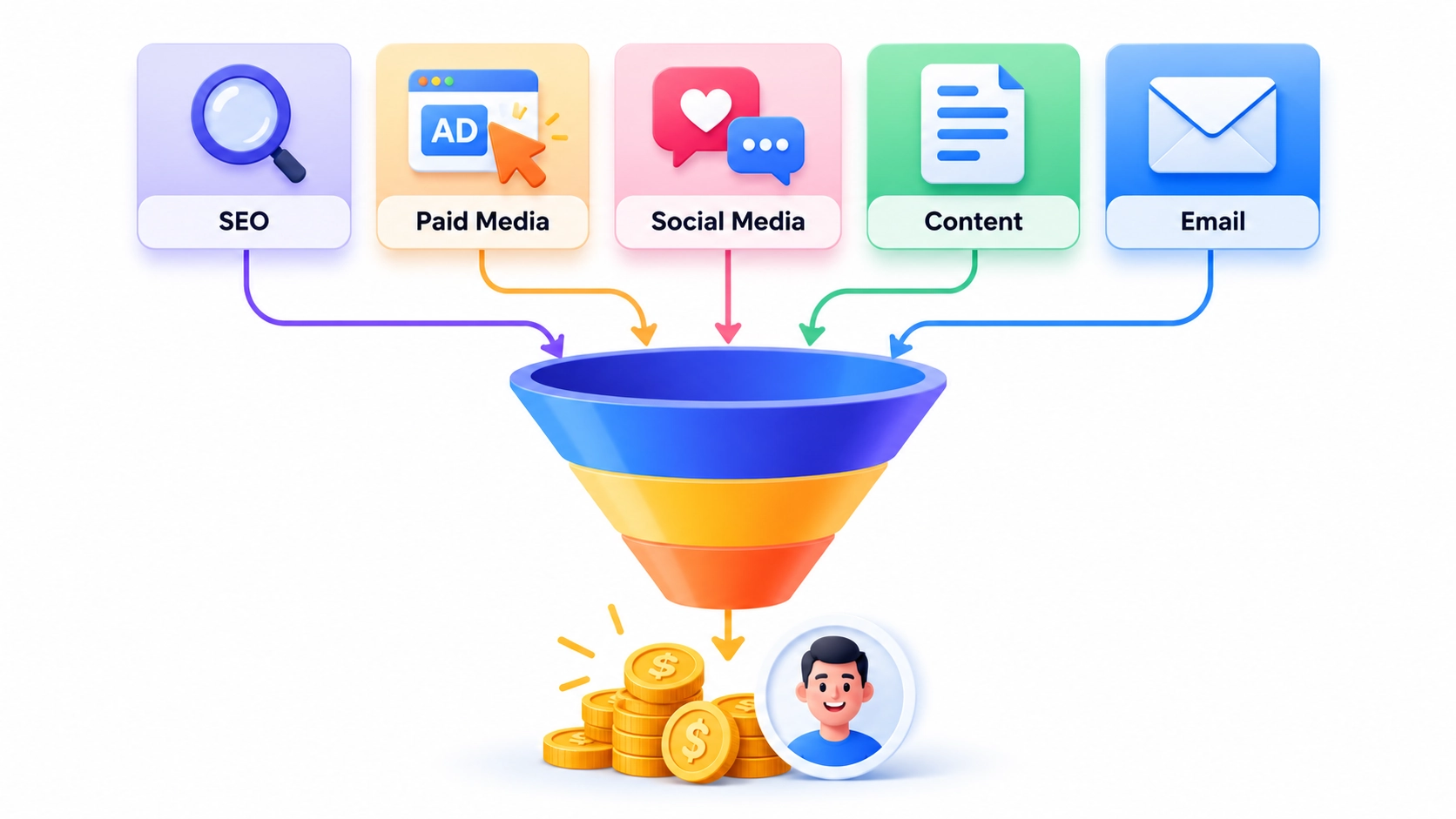
Seen together, these cover the full funnel. Search and social bring people in, content and email build interest, and CRO plus remarketing turn that interest into enquiries and repeat business. A gap anywhere in that chain leaks leads, which is why coordination matters more than any single channel.
Most businesses don’t need every channel running at full intensity from day one. The right starting mix depends on where the biggest gaps currently sit.
Digital Marketing and Google AI Overviews
AI-generated answers are changing search, and the effect reaches well beyond SEO.
AI Overviews now answer a meaningful share of queries directly. They tend to pull from content that is clearly structured and credibly sourced, not from paid placement. That ties content marketing and SEO closely together: the well-built pages that earn organic rankings are also the ones AI systems are most likely to surface.
Paid media isn’t exempt. As AI search changes how people discover businesses, ad strategy has to allow for shorter or different customer journeys than before. With one plan across all channels, a business can respond as search behavior shifts, and nobody has to treat AI visibility as someone else’s job.
What Does Digital Marketing Actually Cost in Delhi?
Pricing spans a wide range because “digital marketing agency” covers everything from a single-channel freelancer to a full in-house-equivalent team.
Three rough tiers cover most businesses. A starter package, usually basic SEO, social media, and light paid ad management, runs ₹15,000 to ₹40,000 a month. Growth packages add deeper SEO work, more active social content, and expanded paid campaigns, and usually land between ₹40,000 and ₹1,00,000. Enterprise or highly competitive multi-channel work starts around ₹1,00,000 and can pass ₹2,50,000 depending on scope. Ad spend for Google Ads, Meta Ads, or similar platforms is always billed separately from these management fees.
Here’s roughly what each tier covers. A starter package usually means one or two core channels done properly, say local SEO plus social media, with a defined set of target keywords, a fixed number of posts each month, and a simple monthly report. Growth adds deeper content work, active ad management on Google or Meta, email setup, and conversion tracking across channels. Enterprise work layers in CRO testing, a fuller content engine, advanced analytics, and often a dedicated account lead who knows the business well.
The pricing model matters as much as the number itself. Retainers work for ongoing SEO and social media, since results build gradually. A website build or campaign setup is better quoted as a one-off project. Then there are performance-linked fees, where part of the cost depends on hitting a target you’ve agreed, such as a cost per lead. They can work for paid media, but only with clear definitions in writing before launch. Whichever model applies, ask for a full breakdown before signing. Surprise charges in month two are a common complaint about agencies.
A quote far below these ranges, or one promising guaranteed rankings and leads, deserves real scrutiny. Get a free consultation for pricing based on your actual channels, goals, and competition rather than a flat number pulled from a brochure.
5 Mistakes That Waste Digital Marketing Budgets in Delhi
Check this list before you sign with any agency, including us.
Separate vendors for SEO, ads, and social, with nobody coordinating them, waste the overlap a single plan would capture. A long contract with no exit clause keeps you tied in even when results never show up. And if the agency creates and owns your Google Ads account, GA4 property, or social handles, you’re exposed the day the relationship ends.
Judging performance by vanity metrics like impressions and follower counts hides whether the spend is working. And expecting SEO-level results within weeks pushes businesses toward tactics that risk long-term penalties for short-term gains.
Our Digital Marketing Process
Every engagement starts with a full audit across whatever channels are already active, not a generic package applied regardless of starting point.
Strategy comes first. We work out the business, the audience, and which channels fit the goals, rather than switching everything on at once. Execution then runs across the agreed channels, with content, campaigns, and technical work built to support each other. Google Ads, GA4, and social accounts are set up or connected with you as owner and the agency added as a user, following Google’s own guidance on managing access to a Google Ads account.
The first 30 days go mostly into foundations: conversion tracking set up properly before any budget goes live, quick technical fixes, and a written 90-day plan with clear milestones. Early wins usually come from fixing what’s already broken, not launching something new. Reporting runs through one view, so SEO, paid, and social results sit side by side. As results come in, the plan gets reviewed and budget moves toward whatever is working.
A typical toolkit behind all this includes GA4 and Google Search Console for tracking, Google Ads and Meta Ads Manager for campaigns, an SEO platform such as Semrush or Ahrefs, and a CRM or email tool like HubSpot or Mailchimp. The tools matter less than whether someone is reading the data and acting on it.
See how this comes together in our portfolio.
Which Numbers Actually Matter
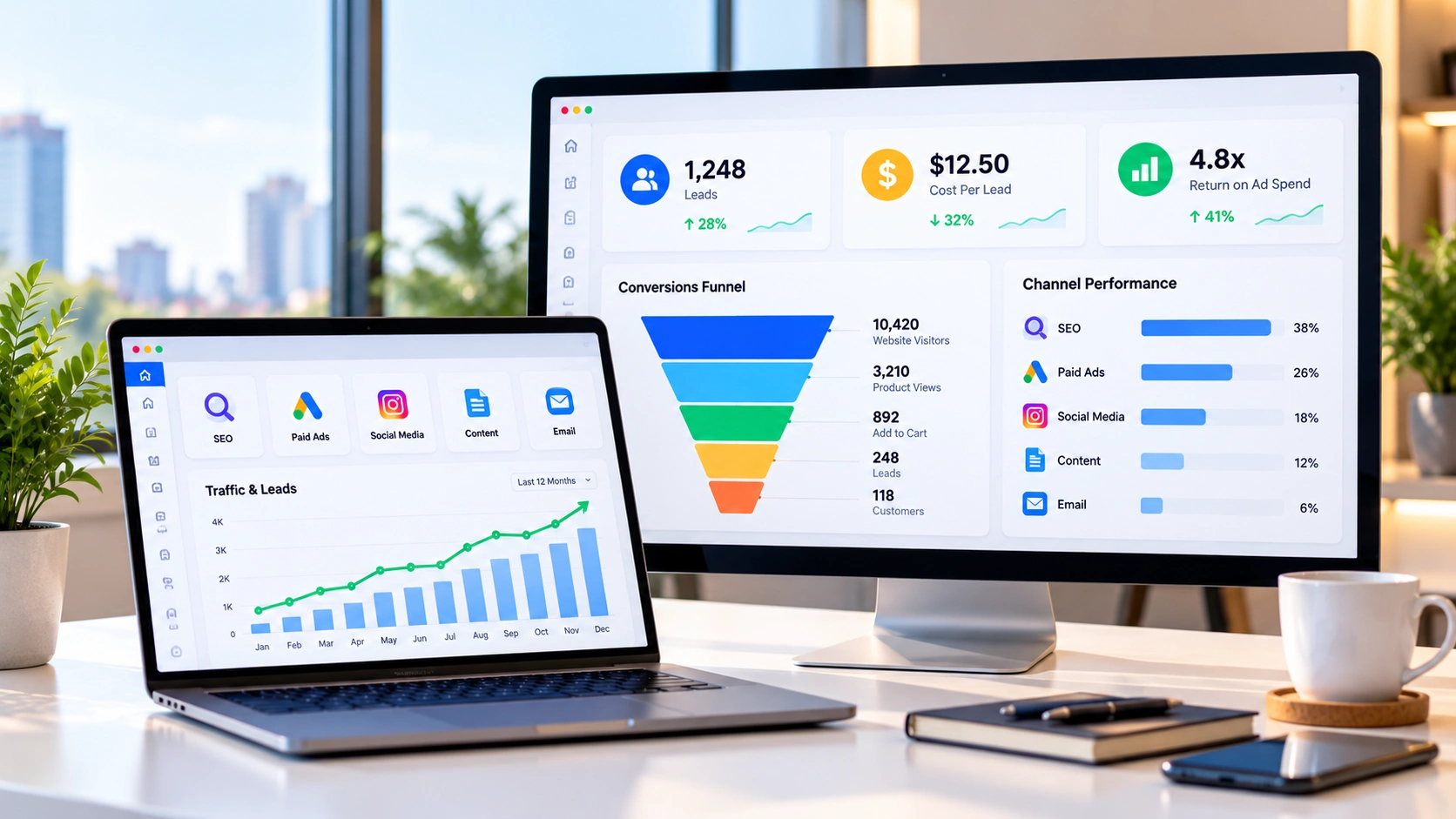
Reports full of impressions and follower counts look busy, but they rarely answer the one question that counts: is this bringing in business?
Lead volume comes first, meaning how many enquiries, calls, and form fills arrive each month. Cost per lead sits right behind it and shows what each of those enquiries costs to generate. Cost per acquisition goes a step further by tracking what it takes to win an actual paying customer.
For paid campaigns, return on ad spend (ROAS) compares the revenue earned against the money put into ads. Conversion rate shows how many visitors take the action you want, and it’s often where the cheapest improvements hide. For businesses with repeat purchases, customer lifetime value reveals what a customer is worth over time, which changes how much it makes sense to spend winning them.
Impressions, reach, and follower growth still have a place as supporting signals. They just shouldn’t headline any report. Ask to see a sample report before signing. If it can’t connect activity to leads or revenue, the agency probably isn’t tracking what matters.
Why Delhi-Specific Market Knowledge Matters
UTS Sites is based in Mohali and works with Delhi NCR businesses through calls, shared dashboards, and regular reports. Where a team sits matters less than how well it understands the market it’s marketing into.
Delhi’s competitive market looks different by area and industry. What works for a Karol Bagh retailer differs from what works for a Gurugram-adjacent B2B firm, so strategy starts with research into how your customers search, compare, and buy.
Coordinating several channels also depends on clear communication. One shared plan, one reporting view, and regular reviews keep SEO, ads, and social aligned, and let priorities shift quickly when something isn’t working.
Our PPC services and content marketing services cover two more of the channels that fold into a full digital marketing strategy.
Full-Service Agency vs. Managing Channels Separately
Running every channel through one agency isn’t always the right call, and the decision depends on how much coordination matters for the business.
A full-service agency makes sense when channels genuinely need to work together, when content built for SEO should also fuel social posts, or when ad campaign data should shape content strategy going forward. Managing channels separately, different specialists for SEO, ads, and social, can work for businesses with simple, independent goals for each channel that don’t need tight coordination.
The tradeoff is coordination overhead, someone still has to align separate vendors, which either falls on the business owner or gets lost entirely. For most small and mid-size Delhi businesses without an in-house marketing lead, one coordinated agency tends to deliver more consistent results than juggling several disconnected vendors.
Industries We Work With in Delhi
The right channel mix for Delhi NCR businesses shifts quite a bit depending on the industry, and experience across sectors shapes what gets recommended.
Clinics and healthcare providers lean on local SEO and reputation management, because patients search nearby and read reviews closely before booking. A property developer wants buyers who are already searching, so paid lead generation plus local content does the heavy lifting. Coaching institutes are a different story. Parents compare before they enrol, so being easy to find on Google and showing proof from past students matters most, especially just before admissions open.
Restaurants, retail, and local services live or die by Google Business Profile, local search, and social content showing the real product or space. E-commerce and D2C brands need paid ads, email, and SEO tightly coordinated, because the path from first click to purchase has to stay short. B2B and professional services usually focus on LinkedIn, content marketing, and search, building credibility with decision-makers over a longer buying cycle.
Whatever the industry, the strategy gets built around how that specific audience actually finds and chooses businesses, not a standard template applied across the board.
Questions to Ask Before Hiring a Digital Marketing Agency in Delhi
Choosing on price or a polished pitch alone is how most bad hires happen, so a few direct questions are worth asking before anything gets signed.
Start with results. Ask for case studies from businesses similar to yours, with real numbers on leads, cost per lead, or revenue rather than a vague claim about improved visibility. Ask what the first 30 and 90 days will look like, and who will handle your account day to day, since you’re hiring a team and not a sales presentation.
Ask which KPIs get reported and how often, and request a sample report to see whether it reads like useful information or decoration. Ask who owns the ad accounts, analytics, website, and social handles, because the answer should always be you. Ask what’s included in the price and what costs extra, then ask about contract length and how an exit works if results don’t show up.
A few red flags are worth walking away from. Guaranteed rankings or guaranteed lead numbers are the clearest one, since no honest agency controls Google’s algorithm or ad auctions. Vague answers about who does the work, reluctance to share sample reports, long lock-in contracts with no exit clause, and pricing that only becomes clear after you’ve agreed are all signs the relationship will be harder than the pitch suggested.
We’re glad to answer every one of these before you commit to anything. A free consultation is a good time to ask.
Related Services
For the search visibility channel within this strategy, see our SEO services. For the social media channel, our social media marketing services cover what that involves. And for the website foundation everything else points to, see our web design services.
Frequently Asked Questions (FAQs)
How much does digital marketing cost in Delhi?
Full-service packages typically run ₹25,000 to ₹1,00,000 a month, with enterprise-level, multi-channel work often exceeding ₹2,50,000. Ad spend is always separate from the management fee. Reach out for a free quote based on your specific needs.
Do I need every channel, SEO, ads, and social, from the start?
Not necessarily. The right starting mix depends on where your current gaps are biggest, some businesses need SEO first, others need paid ads for faster results while SEO builds in the background.
Will I own my Google Ads and analytics accounts?
Yes. Ad, analytics, and social accounts should sit in your name, with the agency added as a user rather than the other way round. That way you can switch agencies later without losing your data or campaign history.
How is this different from hiring separate SEO, PPC, and social media specialists?
Separate specialists each optimize their own channel. One agency plans across all of them, so content written for SEO also feeds social, and what ads reveal about your customers shapes everything else.
How long until I see results across channels?
Paid campaigns can show results within weeks. SEO and organic social usually need 4 to 6 months before the movement is meaningful. Because the channels work together, overall business impact often shows up sooner than any single channel would deliver alone.
What should I ask a digital marketing agency before hiring?
Case studies from similar businesses come first, followed by who owns your ad and analytics accounts, which KPIs get reported, what the price includes, and how the contract can be ended. The section above walks through the full list along with the red flags to watch for.
Is a monthly retainer or performance-based pricing better?
Retainers suit ongoing work like SEO and social media, where progress builds a little at a time. Performance-linked fees can work for paid campaigns, as long as the target (a cost per lead, say) is spelled out in writing before launch. A mix of the two is also possible, with a retainer covering the base work and a performance element tied to ad results.
Ready for Marketing Channels That Actually Work Together?
Get a free consultation for your Delhi NCR business. We’ll look at what’s currently running across your channels and show you what a properly coordinated strategy could mean for your leads and growth. Talk to Our Digital Marketing Team →